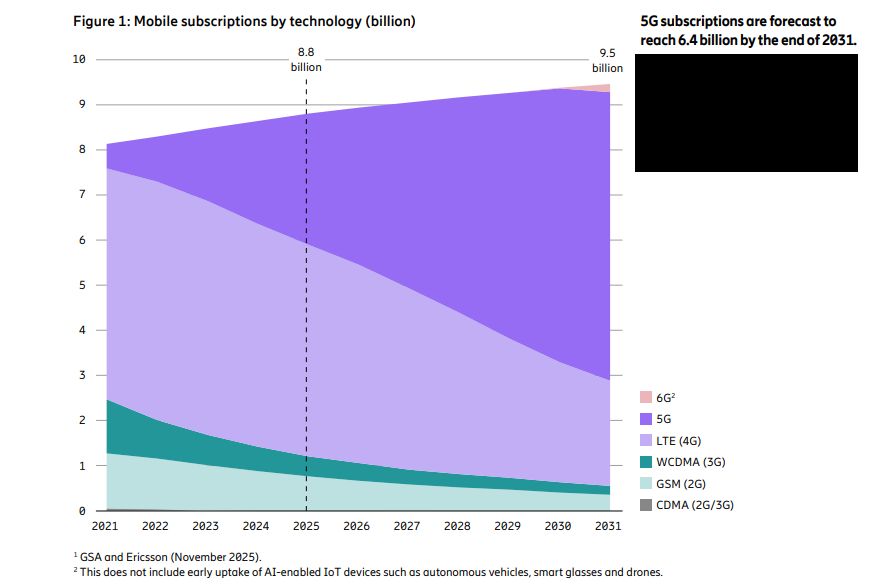
5G (and 4G) Snapshot Worldwide Forecast published by Ericsson, Sweden in November 2025 5G currently 2.8 billion, plan is 6.4 billion in 2031
LTE=4g, WCDMA/HSPA=3g, GSM and GPRS and others=2g. 2g is switched off in Australia & 3g was switched off 28 Oct 2024.
At the close of 2025, 4G subscribers worldwide are still very high at just below 4.8 billion, 5G 2.8 billion, 3G about 460 million and 2G about 760 million.
The top 100 tower companies in the world control and manage over 1½ million buildings that house shared telecommunications infrastructure. This figure does not include China (2 million) or Russia (85,000).
In the US (307,000) the carriers have effectively exited the tower business. Most sold their towers to companies like American Tower (AMT) and Crown Castle. They construct, maintain and operate the towers, and lease space back to the carriers.
In Australia in 2017 there were 21,472 base stations. 7772 towers were owned by Telstra with other owners NBN, Optus, Vodafone, Ericcson, Nokia (and others). In 2021 Optus auctioned off all its towers. The towers are currently erected and maintained by subcontractors - Comstar, Westcom and Pacific Towers. With 5G poles, many are owned by local governments, and Transport departments.
Telstra showed 11,302 base stations 5G launched 28 May 2019 (4,559) 4G (9,214)
Optus 8,821 base stations 5G launched August 2019 (2,905) 4G (7,425)
Vodafone/TPG 5,769 base stations 5G launched March 2020 (2,063) 4G (5,457).
GSM Frame Structure
GSM, 4G (LTE) and 5G all have different frame structures and use distinct technologies for data transmission and network architecture. GSM, primarily a 2G technology, uses a time-division multiple access (TDMA) system with fixed frame and slot structures. 4G LTE (having two antennas) uses a more flexible Orthogonal Frequency Division Multiplexing (OFDM) approach with static subframes and slots. 5G NR (having 4 antennas) utilizes even more flexible subframe and slot structures
GSM (2G) Frame Structure:
GSM uses a TDMA system where a frame is divided into 8 slots, each carrying a single burst of data.
Each frame lasts 4.615 ms and contains 160 bits of information.
4G (LTE) Frame Structure:
4G LTE uses a more advanced OFDM technique to transmit data across multiple subcarriers within the same bandwidth.
Each frame is divided into 10 subframes, with each subframe lasting 1 ms.
...