According to Toronto based company Quantumrun their report in May 2026 declared "Global cloud computing crossed the trillion-dollar mark in early 2026, with public cloud end-user spending forecast to hit $850 billion this year alone. AWS (30%), Microsoft Azure (25%), and Google Cloud (13%) in Q1 2026 now control 68% of all enterprise cloud spending, while 94% of enterprises run workloads in the cloud."
Not surprisingly, many enterprises, banks, hospitals, airports, government departments use a hybrid of the public cloud (about 85% of total cloud) and private (15%), with private end-user cloud spending safeguarding data from third parties, estimated at $150 billion.
Some definitions
Data Centres for websites: its steady worldwide growth since 2010 has seen Australia become a regional hub. Inside Australia, Airtrunk, owned by Blackstone since 2024, is the largest data centre owner with investments in Sydney, Singapore, Tokyo, India, Hong Kong and Malaysia. Its major clients are Amazon, Microsoft and Google. Its nearest competitor is NextDC. For their similarities and differences, click here.
| Name | (Elastic) Services | Est.Revenue $US billion |
|---|---|---|
There are 4000 AWS AU employees Sydney, Melbourne, Canberra, Brisbane, Adelaide and Perth noting that Amazon's total workforce is over 7000 | LinkedIn, Facebook, Baidu (Chinese Search Engine), Twitter, Adobe, BBC, | IaaS $95bn PaaS $55bn SaaS $2½bn |
| 2. Microsoft Open 1975 Cloud 2008 There are 3000 AU employees Sydney, Melbourne, Canberra, Brisbane, Adelaide, Perth | Millions utilize OneDrive and MS Office on the web while many companies, government depts utilize Microsoft Azure | IaaS $75bn PaaS $54bn SaaS $68bn |
| 3. Google Workspace Open 1998 Cloud 2008 2300 AU employees Sydney, Melbourne, with a hub in Adelaide | Launched as Google Apps for Your Domain, rebranded as G Suite in 2016, rebranded again in 2020 as Google Workspace. In 2026 G Suite had 11 million paying businesses. Education users (students and educators) surpass 170 million | IaaS $42bn PaaS $28bn SaaS $14bn |
| 4. Salesforce Open 1999 Cloud 2009 2800 AU employees AWS Sydney, Parramatta, Melbourne, Brisbane | Dominant Customer Resource Management SAAS | IaaS $0bn PaaS $8½bn SaaS $34½bn |
| 5. Alibaba Group Open 1999 Cloud 2009, based in China | Largest infrastructure footprint outside Western tech. IaaS similar to AWS | |
| 6. Oracle Cloud Open 1977 Cloud 2016 2000 AU employees Sydney, Melbourne, Brisbane | Enterprise and Business Software. Owns Sun Microsystems (Stanford) in 2010, Java language, Javascript trademark, works closely with Microsoft | IaaS $11½bn PaaS $14½bn SaaS $15bn |
| 7. SAP Open 1972 Cloud 2012 1200 AU employees Sydney, Melbourne, Brisbane, Perth, Canberra, Adelaide | Founded in Germany and US by a group of IBM techs. Leading provider of Enterprise Resource Management Apple, Walmart, Amazon, Coca-Cola, Ford, etc | IaaS $0bn PaaS $7bn SaaS $30bn |
| 8. IBM Cloud Open 1911 Cloud 2013 3000 AU employees Sydney, Melbourne, Canberra, Brisbane, Adelaide and Perth with a Regional Tech Centre in Ballarat | 92% of Top 100 Banks, Tax, GST, Centrelink, Westfield, Woolworths, Airports, Health | IaaS $7½bn PaaS $16½bn SaaS $9bn |
| Apple iCloud Open 1975 Cloud 2011 4000 AU employees Sydney Brisbane Melbourne Adelaide Perth | While Apple refuses to release any Cloud statistics, it has over one billion iPhones in active operation, most of which rely upon the cloud.
Since 2011 it has used both AWS & Microsoft Azure & since 2016 Google | |
| Estimated Revenues in 2026 based on Gartner's Definitions and a Google AI conversation | ||
Cloud computing in 2021 has become the de facto choice of IT due to digital transformation shifts accelerated by remote work and the COVID-19 pandemic. Here's a look at how the cloud leaders stack up, the hybrid market, and the key SaaS players.
Click here for this report in April 2021 from ZDNET by Larry Dignan
and this report (showing little change) in 2024
Extract from original report in 2018: Why Microsoft Is Ruling The Cloud (in 2018), IBM Is Matching Amazon (temporarily), And Google Is $15 Billion Behind
Feb 5, 2018
Bob Evans
www.forbes.com
After award-winning career in media covering the tech industry, Bob Evans was VP of Strategic Communications at SAP in 2011, and Chief Communications Officer at Oracle 2012 to 2016. Now runs own firm, Evans Strategic Communications LLC
While Google Cloud Platform is showing huge potential, in 2017 it's far behind revenue leaders Microsoft, Amazon and IBM in the Cloud Wars.
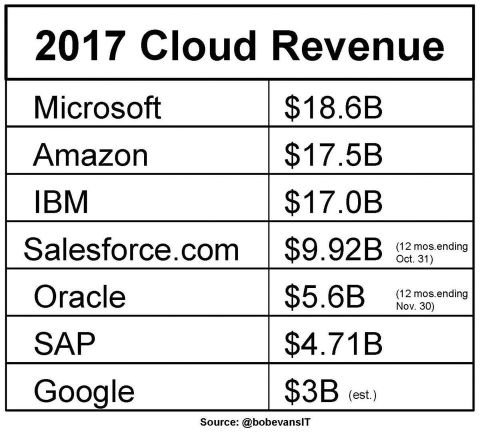
For calendar 2017, the seven biggest enterprise-cloud vendors — Microsoft, Amazon, IBM, Salesforce, Oracle, SAP and Google — posted cloud revenue of $76.3 billion, as compiled from those companies' publicly available earnings results.
| |
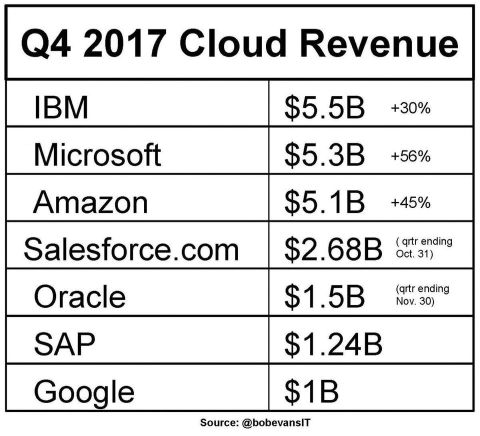
Google Cloud Platform's achievement of $1 billion in Q4 revenue is outstanding — but it's also a clear indication that Google, for all of its astonishing technological and financial resources, has not until recently taken this market seriously. While the longtime media trope has been that SAP and Oracle have been "late to the cloud," these numbers reveal that if any of the major cloud vendors truly deserves to have to wear a T for tardy, it is Google. Now that Diane Greene and company have things on track, it will be most interesting to see how GCP fares in the Cloud Wars in 2018 and beyond.
So, let me conclude with a couple of thoughts on each of these leading enterprise-cloud vendors as they jointly escalate the Cloud Wars here in early 2018 to the very great benefit of business customers.
Some Definitions SaaS Software as a Service IaaS Infrastructure PaaS Platform
Microsoft is all about the hybrid cloud, and it's a subject that CEO Satya Nadella returns to relentlessly, citing his company's success in the cloud as being due to its creation of aggressive deployment of its architectural advantage in seeing no big difference between on-premises technology, cloud technology, and IoT edge technology.
Amazon is doing terrific work on many fronts, and were it not for Microsoft above it and IBM just behind it, Amazon would deserve all the hosannas the media loves to lavish upon its cloud business. But reality often intrudes on rickety narratives, and if Amazon wants to remain a top-tier cloud powerhouse, it must increase its presence in the higher-value realms of PaaS and SaaS.
IBM has not only created an "as a service" cloud business approaching $10 billion, but it has also exploited with great success its "power of incumbency" among the world's largest corporations by offering hardware, software and consulting services to help those customers convert their legacy systems into cloud or cloud-compatible environments. That's become a $7-billion business for IBM with some outstanding customer use cases.
Salesforce continues to be unique (as if a company run by Marc Benioff could be anything else), innovative, and fast-growing. Having hit $10 billion, Benioff is hell-bent on getting to $20 billion in just a few years, but he and his company will have to continue finding new revenue categories, notably in the platform area.
Oracle has a fast-growing SaaS business accounting for about 75% of its total cloud revenue, but chairman Larry Ellison has said many times that he believes Oracle's PaaS business will become even bigger than its SaaS business, particularly as the database-as-a-service offering gains momentum among customers. Ellison also believes Oracle's advanced IaaS technology can snatch huge chunks of share from Amazon.
SAP's power of incumbency is centered on being and having been the world's leading supplier of enterprise applications for many, many years, giving it a great opportunity to help those trusting customers pivot as much of that on-premises technology as possible over to the cloud. SAP's still working through some of that massive end-to-end transformation to the cloud, and when that process is complete it will be an even more formidable competitor than it is now.
Google is, well, Google, and it's got not only tons of technical chops and tons of money to invest but also, at long last, a concerted sense of purpose and will towards becoming a very serious player in the enterprise cloud. It's starting from pretty far back in the pack, but never count out a company whose name has become a verb.
** End of page